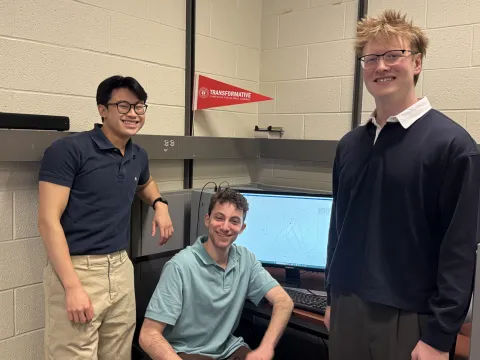
Nathan Nguyen, Scott Blender, and Joseph Mergen
Rensselaer Polytechnic Institute (RPI) engineers have long played a major role in space exploration, designing infrastructure that makes sure space operations are efficient, precise, and scalable. That continues today with Artemis II, commanded by RPI alumnus Reid Wiseman’97, the first mission to the moon since 1972! The upcoming mission will have four astronauts orbiting the Moon in the Orion spacecraft for ten days. Artemis II will be the first full test of the deep-space exploration system that NASA has created with a full crew on board.
At RPI, Students and alumni are advancing technologies that support missions like Artemis II, including work in the Advanced Space Concept Lab (ASCab) led by Sandeep Singh, Ph.D.
“My vision for the Advanced Space Concepts Lab is to investigate topics at the cutting edge of research in Space spanning: Next-gen Space Domain Awareness, Autonomous Space Systems, AI for Space Applications, and Mission and Trajectory Design,” said Sandeep Singh, Ph.D. “I envision students undertaking research at the intersection of these topics as a part of the lab to develop into critical thinkers and develop a strong, independent research acumen. Students from the lab have already secured internships and full-time positions at NASA Johnson Space Center, Vantor (formerly Maxar), Raytheon, and Lockheed Martin, among others. This is evidence that their experiences at ASCLab and RPI have placed them in the upper echelons of new graduates, making them exceptionally capable for the space industry”.
Scott Blender, a 2nd-year Ph.D. Aerospace Engineering Student has an upcoming internship at AstronetX as an Astrodynamics and Optimization Intern. He will be working to determine the best locations on the lunar surface to place telescopes that will track the spacecraft with high accuracy. Scott's experience at AstronetX will apply to his Ph.D. research. Scott will study how multiple satellites can observe many targets simultaneously from several different angles. This study will help shape his candidacy and dissertations; in the future, his goal is to someday build a system that could support missions like Artemis II.
Joseph Mergen will be graduating with his M.S. in Aerospace Engineering this May with a full-time position at Lockheed Martin Space as a Satellite System Engineer in Operations. Joseph’s thesis focuses on developing Space Domain Awareness (SDA) systems to track objects between the Earth and Moon, which is becoming crowded due to spacecraft, satellites, and orbital debris. Joseph has developed a concept called “Dynamic Cadence,” which reduces constellation (network of satellites) demand while maintaining accuracy.
Alumnus Calvin Chan, M.S in Aeronautical Engineering, founded the RASC-AL Club, an aerospace-focused club. The Club competes in the RASC-AL competition, hosted and funded by NASA. Where teams choose from given topics and design innovative solutions. Calvin’s team designed a rover for scouting missions for Mars exploration. Calvin is looking forward to his new position at Vantor. He will be working as a (GNC) Aerospace Engineer. In this position, Calvin will oversee spacecraft maneuvers to ensure accurate capture of high-resolution images from Vantor’s satellites.
Nathan Nguyen will graduate this year with his Aerospace M.S. degree and will join NASA’s Johnson Space Center as an Orion GNC Engineer. In this role, he will support guidance, navigation, and control systems that enable precise spacecraft docking. His graduate research applied machine learning to lunar navigation to help future missions land more accurately on the Moon. During his previous NASA internship, Nathan also worked on improving surface navigation techniques for lunar exploration.
Taken together, these accomplishments demonstrate the steady progress being made across RPI’s aerospace community. They set the stage for a broader reflection on the impact these students and alumni are already having in the field.
For these students and recent alumni, their passion for space exploration has driven them to success. They have navigated challenging, complex research, secured competitive positions and internships, and created a strong sense of who they are in their aerospace careers. They hold great promise for the future and the continuation of RPI’s legacy of leadership in space research.
Categories Campus and Community, School of Engineering, Mechanical Aerospace and Nuclear Engineering
Press Contact Calleigh Pellitier, pellic@rpi.edu
